The clear answer
Why won’t my Slushi freeze?
A helpful checklist for a batch that is not reaching the texture you expected.
it out!
You poured in your drink, picked a preset, and waited. The machine is humming, the mix feels cold, and it is still soup. The good news is that a batch refusing to slush is almost never a broken machine. It is usually the mix itself: the sugar balance, the alcohol level, the starting temperature, or how much liquid is in the vessel. Work through the checks below in order, change one thing at a time, and most batches come around.
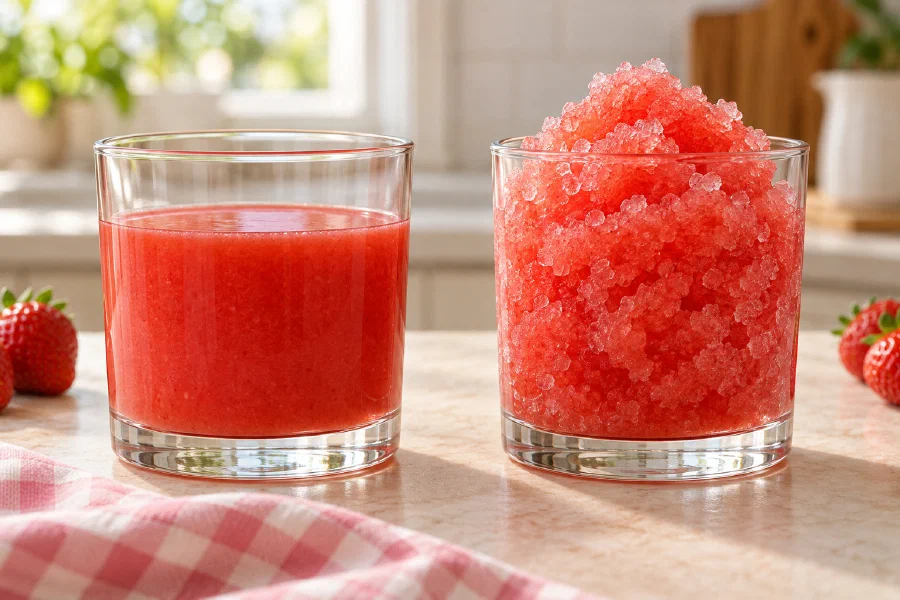
Flat surface, freely flowingFrozen slush
Heaped, granular crystals
Start with the sugar
Sugar does far more than sweeten your drink. It sets the freezing point of the mix, and that is what lets fine, soft crystals form and keep moving instead of locking together into a solid block of ice. Every liquid you pour in needs at least 4 percent sugar, which you can read straight off the nutrition label as 4 grams of sugar per 100 millilitres.
Too little sugar is the most common troublemaker. Diet drinks, no added sugar juices, and drinks sweetened only with artificial sweeteners fall short, and the mix freezes in a hard layer on the drum while the rest never becomes slush. The machine will often tell you: if the temperature lights chase downward one at a time and the unit beeps once a minute, sugar is the problem. Stir in 1 to 2 tablespoons of syrup, juice, sugar, honey, agave, or maple syrup for every 8 ounce serving, then restart the preset.
Too much sugar causes the opposite failure. Very sweet mixes built on cordials, syrups, or sweet liqueurs can sit liquid for hours because all that sugar pushes the freezing point down too far. Dilute the batch with 1/4 cup of water per serving and give it more time.
Check the alcohol
Alcohol freezes at a far lower temperature than water, so a generous pour works directly against the machine. On the spiked slush preset, the total alcohol in the mix needs to land between 2.8 percent and 16 percent. A useful measure for spirits is 4 ounces of hard alcohol for every 24 ounces of total mix.
If the mix goes over the limit, the temperature lights chase upward one at a time and the unit beeps once a minute. The fix is dilution: add 1/4 cup of water, soda, or seltzer for every 8 ounce serving, press the preset once to reset, then press it again to restart. Wait 30 minutes and repeat if the batch is still thin. If the vessel is already full, dispense a glass first to make room.
Start cold and stay between the lines
Warm liquid is slow liquid. A mix that goes in at room temperature can take far longer to firm up than the same mix cold from the fridge, so chill everything before it goes in. Hot ingredients should never go into the vessel at all.
Fill matters just as much. Keep the liquid between the minimum and maximum lines on the vessel, which means at least 16 ounces and no more than 64 ounces. Below the minimum there is too little liquid to churn properly, and above the maximum the mix is crowded, expands as it freezes, and struggles to freeze evenly.
Your kitchen plays a part too. Run the machine indoors, and not in a room hotter than 100 degrees Fahrenheit. A hot room fights the cooling system the whole way and can turn a borderline mix into one that never gets there.
Give it time, then adjust the temperature
A batch is not late just because it is not ready in ten minutes. Depending on the volume, the ingredients, and the starting temperature, drinks can take up to 60 minutes to reach a proper slush.
If the texture is still not there after 60 minutes, raise the temperature control by one level using the up arrow, then wait 10 to 15 minutes and look again. If it is still too thin, go up one more level and repeat. Small steps beat big ones here, because each level needs time to show in the texture. Spiked drinks live at the cold end of the range, so a cocktail mix may need the highest levels before it firms up.
If you overshoot and the slush turns too thick to pour, do the reverse: lower the temperature control by a level or two and add 1/2 cup of liquid while it runs.
Frequently asked questions
Why will a diet soda not turn into slush on its own?
It comes down to sugar. A slush needs at least 4 percent sugar to form soft crystals, and diet drinks sweetened with artificial sweeteners fall far short of that. Stir in 1 to 2 tablespoons of syrup, juice, sugar, or honey for every 8 ounce serving and the same drink will usually slush up fine.
My drink has run for an hour and it is still liquid. What should I try first?
Raise the temperature control by one level and wait 10 to 15 minutes before you judge it. If it is still thin, the mix itself is the likely problem. Too much alcohol or too much sugar both hold a batch liquid, so add 1/4 cup of water per serving, restart the preset, and give it another 30 minutes.
Can I pour in a warm mix to save time?
You can, but it will cost you time instead of saving it. Warm liquid takes far longer to reach slush, and hot ingredients should never go into the vessel at all. Chill the mix in the fridge first and your drink will firm up much sooner.
Does the amount in the vessel really matter?
Yes. Keep the liquid between the minimum and maximum lines, which means at least 16 ounces and no more than 64 ounces. Too little liquid freezes in a hard layer instead of churning, and too much leaves the mix crowded and slow to freeze evenly.
More helpful guides
See all tips & tricks → Creami
Your first Creami pint
A simple introduction to your machine, preparation and first frozen creation.
 Slushi
Your first Slushi batch
Get to know compatible liquids, fill lines and your first frozen drink.
 Creami
Why is my Ninja Creami crumbly?
Understand the texture, check the basics, and find the next step for your pint.